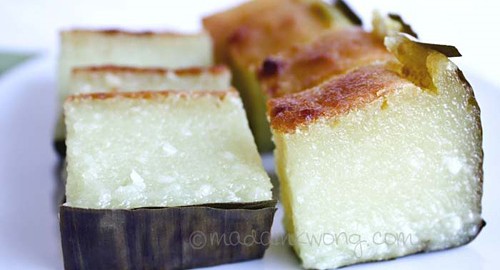
Firstly, I wish to thank Nyonya Food for inviting me to guest post in her amazing blog. I was so excited when she emailed me and am truly honored. We share something in common, well, besides cooking, speaking the same language or the love of food. We are both from our beautiful island of Penang, Malaysia. She wanted me to “cook up” a Nyonya dish. The choice of Nyonya cooking is vast and hard but this recipe is very simple. Oh! She did hint she wanted a kuih. So, I whipped up Kuih Bengka. My daughter, the amateur photographer, Suz took the photos and soon enough ate most of the kuihs.
In the past where there was no electricity, Nyonyas used charcoal to bake Kuih Bengka (Cassava). The top of the kuih would become dark brown. These days, you can still get the same top crusty effect in a fan forced oven which is caused by the baking process. The kuih is light yellow in colour and has a sweetly scented coconut flavor. You can even bite into the grated coconut. I used the old fashion wooden coconut grater to grate the coconut in this recipe. Ahhh! Life is hard, knowing that you can buy frozen grated coconut. This is an easy recipe to make and hope you try it as well…
Kuih is a fairly broad term which may include items that would be called cakes, cookies, dumplings, pudding, biscuit, or pastries in English and are usually made from rice or glutinous rice.
Note: One cup is approximately 250g. The one tin of coconut milk is 2 cups but you’ll be adding water, making a litre in total.
Ingredients:
1kg finely grated cassava (tapioca)
4 cups sugar
1 tin coconut milk and add water to make 1 litre in total
3 heap tablespoons plain flour
250g freshly grated coconut
Method:
Mix the grated cassava, grated coconut and flour in a large mixing bowl.
Heat up the coconut milk together with sugar. When the sugar starts to melt, add this mixture into the combined cassava mix. Use a balloon whisk to stir thoroughly.
Lastly pour into a 8”X 8”X 3” tin, either lined with grease proof paper (baking paper) or banana leaves.
Bake in the oven at 180 degrees Celsius for 2 hours.