VERY useful info on incorporating alternative sweeteners to make a smooth texture in frosting.
First off, check out this article in which the research on dietary fat is discussed. Our nutrition philosophy is getting more and more positive press!

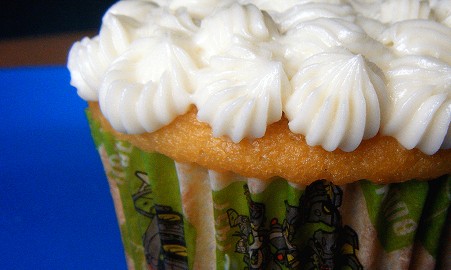
(Please ignore the robots on the paper liners. They were on sale!)
Since posting my chocolate cake made with black beans last month, I’ve received quite a few requests for a vanilla version of this incredibly moist, easy recipe. You ask, I deliver! These gluten-free sugar-free low carb (grain-free!) yellow cupcakes are made with coconut flour in place of the cocoa powder, and white beans instead of black beans. Cocoa powder and coconut flour seem to work interchangeably! It’s a pretty cool discovery that I hope y’all can make use of in your own gluten-free low carb baking pursuits. And because someone will ask: These cupcakes do not taste like beans or coconut! Just butter and vanilla and moist yumminess. Using beans and coconut flour in place of almond flour is budget-friendly, so you can experiment with this recipe by adding cinnamon, nuts, sugar-free chocolate chunks, different extracts… have fun!
But wait, looks like Kelly over at The Spunky Coconut beat me to the punch! Her yellow cake with chocolate frosting looks scrumptious. Be sure to check out her take on this cake (and all other tasty recipes!) at her beautiful blog.
As for the frosting (a.k.a the ONLY reason for eating cake)? I’ve got you covered there. Professional bakery icing, the kind made with shortening and white sugar, always appealed to me. It’s something about the pure whiteness of the frosting, the supercharged vanilla flavoring, and memories of cupcakes from a bakery in my hometown. The almost artificial taste that you know means it can’t be good for you!
Fortunately, tweaking this type of frosting to be low carb and healthful is only challenging with respect to the sweetener substitution. Even using transfat free organic palm oil shortening, the problem lies in getting rid of the gritty, “cool” quality that xylitol and erythritol (my preferred naturally occuring sugar substitutes!) can lend to heavily fat-based recipes. And stevia alone has no texture to provide structure or cut the greasy mouthfeel of the fat.
Enter swiss meringue buttercream, the ultra smooth egg white based frosting that is commonly found on wedding cakes. Dissolving xylitol in the egg whites seem to fix the texture issues beautifully. Adding a pinch of stevia rounds out the sweetness perfectly. The clear vanilla extract I found at the grocery store maintains that blindingly white hue, and that fake vanilla taste lends a certain authenticity that can’t be achieved with the real deal. The clear vanilla is also ideal for the cake part of the recipe–it doesn’t muddle the golden coloring.
Regarding the sweetener, I’m not positive that erythritol wouldn’t become gritty. I am out of it right now, and have only tested this recipe with xylitol. The great part about working with xylitol is that it forces you to have portion control if you are sensitive to it! Finally, the question of whether to use butter or shortening in this recipe can only be answered by you. I honestly don’t enjoy the “buttery” taste of frosting made with real butter, but it works well here if you’d like to use it. The positive aspects of making this frosting with nonhydrogenated shortening are that a) the vanilla flavor comes through better, and b) it’s dairy-free! This sugar-free low carb icing will taste so real that I advise you make a very small batch if you’re a frosting fiend like I am.

Healthy Yellow Cupcakes
Makes 12 cupcakes
Ingredients:
1-15 oz can white beans, rinsed (I used cannellini beans, white kidney beans) OR 1 1/2 cups cooked white beans
5 large eggs plus 1 yolk
6 tablespoons unsalted organic butter OR nonhydrogenated shortening
3/4 teaspoon good-tasting pure stevia extract (NuNaturals brand)
3/4 cup erythritol OR 2/3 cup xylitol OR 1/3 cup honey
4 teaspoons vanilla extract (clear imitation vanilla is recommended)
6 packed tablespoons Bob’s Red Mill coconut flour
1/2 teaspoon sea salt
1/2 teaspoon baking soda
1 teaspoon aluminum-free baking powder

Preparation:
Preheat oven to 350 degrees Fahrenheit.
Rise beans in a fine mesh sieve and shake off the water. Blend beans with the eggs, vanilla, and salt. In a large mixing bowl, cream softened butter and sweetener until light and fluffy. Beat in pureed mixture. Measure out the coconut flour like you would cocoa powder, by spooning it straight from the bag, packing it down a bit, and sweeping the top of the spoon level. Add to the batter along with the rest of the dry ingredients, and whip together for another minute or two until fluffy. Spoon batter into paper liners sprayed with extra virgin olive oil spray. I use a 1/4 cup measure to distribute batter. Fill cupcake liners a little more than 3/4 way full. Rap muffin pan on the counter a few times to pop any air bubbles. Bake cupcakes for 25 minutes, or until springy to the touch. I set my oven to 325 degrees because it runs hot, but 350 degrees should be just right for accurate, calibrated ovens. The cupcakes will be golden brown around the edges. Let cupcakes sit for 24 hours, so that all of the bean flavor disappears. This is important, really! Hide them from yourself if you must (just don’t forget about ’em!). Enjoy your moist cupcakes with absolutely no beany taste.
~4g net carbs per 1/12th of a recipe, using erythritol

Sugar-Free Buttercream Frosting
Makes enough to frost 3-6 cupcakes
Ingredients:
1 large egg white
1/4 cup xylitol (honey might work as well)
6 tablespoons unsalted organic butter or nonhydrogenated shortening, cut into chunks
Pinch good tasting pure stevia extract (optional, for best flavor)
Big pinch sea salt
1/2 teaspoon vanilla extract (clear imitation vanilla recommended)
Preparation:
Step by step photos for making a swiss meringue buttercream icing can be found here.
Whisk egg white together with xylitol in a stainless steel bowl set over a small saucepan full of water. You don’t want the bottom of the bowl to touch the water. Set heat to medium-low to bring water to a simmer. Whisk egg white with xylitol 3-5 minutes, or until xylitol is completely dissolved. Dip clean fingers into egg white mixture, and pinch for any undissolved granules. Mixture will appear white and foamy. Remove steel bowl from water, and beat egg white mixture until it has about doubled in volume, and is room temperature (cool to the touch). Beat in vanilla and salt. Add chunks of softened butter or shortening, one at a time, beating for 3-5 minutes until mixture is smooth and no longer curdled. Beat in a tiny pinch of stevia and taste for sweetness, making adjustments if necessary. Don’t fret if your buttercream doesn’t look smooth for awhile–it will eventually come together!
If after incorporating the butter the icing is too “loose” and soupy, sit the mixing bowl in an ice bath to cool, or stick the bowl into the freezer for a few minutes, and try beating again. If the mixture is chunky like cottage cheese, heat the bowl over the simmering water again and try beating until it comes together into a smooth icing. Use a spatula to smooth out the consistency. Finally, if you think the frosting tastes too “greasy,” trying cutting back the butter by one or two tablespoons. Leave out the stevia. It will be considerably sweeter, though.
Transfer frosting to a piping bag, or just spread directly on cupcakes. To revive refrigerated frosting, microwave it for 5-8 seconds, and stir around bowl with a spatula until smooth and creamy again. Or whip until fluffy with beaters.
~0-26g net carbs per batch of frosting, depending on how you count xylitol