

There’s something comforting for an historian like me to know that some people make a life out of preserving food traditions. As Ruhlman said during the conference, “food is our humanity” and these people are our humanity keepers. Keeping traditions alive is a testament of our ability to understand passion for quality and care. I see that every Saturday morning when I go to the farmers market in downtown Charleston. We have genuine artisans among them, people with the skills of working their product in an ethical and organic fashion. To pass their passions and a bit of their story on to us everytime we go and take the time to chat for a couple of minutes.
It’s a special treat to see these farmers’ eyes light up with every question I ask or when I tell them what I cooked or baked with the produce or meats I got the week before. There is an exchange far beyond that of goods and paper bills. There is humanity. I always feel a little closer to that when I can buy a product in its raw form and turn it into something else, simply by applying the teachings of other artisans I met when I worked in restaurant kitchens. Food artisans and food lovers would be miserable without one another.

I was really excited to get the first delivery of fresh goat’s milk of the morning the other day at the market. I bought more than two people would consume in one week and I know the people at Joseph Fields Farm thought I was a bit strange. I had a plan. I had been craving faisselle, a soft large curd cheese I grew up eating and wanted to make a few batches with goat’s milk for a change. I think if I were to become an artisan, I would raise goats and make cheese. I am serious.
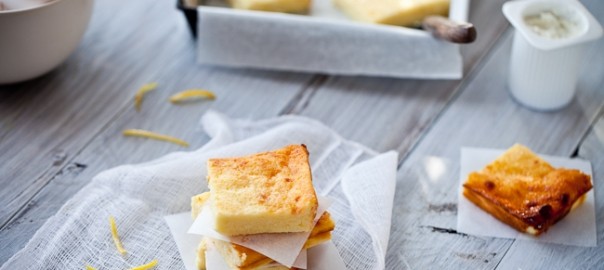
I made so much faisselle that I quickly had to think about ways to use it. I love it barely drained from its whey with a bit of honey and a sprinkle of walnuts in the Winter. In the Summer, I like to mash up so raspberries and sugar along with it. In the Fall? Well…I had never thought about that one. Yet. Until one of our friend mentioned that his work stint was over with here and he was moving back to his native Corsica. I told him to come over for dinner and I would make Fiadone with the fresh faisselle I had just made.

I have spent very little time in Corsica but it was enough to fall in love with its people, its landscape, its energy and its food. One thing I loved almost as immediately as it hit my lips was the Corsican dessert Fiadone. It’s really a cross between a flan and a cheesecake and usually made with brocciu, or brousse, a slightly curdles soft cheese made from cows or goats. All I had to do was make the faisselle, drain it as I would fresh cheese and we were in business.
I know not everyone has access to fresh goats milk to make faisselle for this dessert and the good news is that you can substitute ricotta or well drained yogurt in the same proportion. It is light and refreshing and you can really boost up the flavors anyway you want. We like it with loads of lemon zest but orange or freshly cut pear slices on top would be perfect for the season. Hope you give it a try!

Fiadone, adapted from “Fromages Frais Maison” by Cathy Ytak
Serves 6-9
1/2 cup sugar
3 eggs
zest of one lemon
1 tablespoon cornstarch
pinch of salt
1 cup drained faisselle or ricotta cheese
Line an 8×8-inch sqaure pan with parchment paper, butter lightly and set aside.
Preheat the oven to 375F and position a rack in the middle.
In a large bowl, whisk together the sugar and the eggs until pale. Add the lemon zest, cornstarch and salt and whisk until blended. Add the drained cheese and whisk well.
Pour into your prepared pan, place into the oven and lower the heat to 350F. Bake for 45 minutes. The cake does not rise, it gets dark around the edges and a knife inserted in the middle should come out clean. Let cool for a few minutes before sharing.
To make faisselle without the traditional molds (what I do at home):
Heat up 4 cups of raw milk or whole milk (cow or goat) and 1 cup of Greek yogurt (full fat) into a large saucepan until the mixture reaches 30C.
In the meantime, place 6 drops of rennet (found at healthfood stores) in the bottom of a large, super clean, bowl.
Once the milk mixture has reached proper temperature, slowly pour it into the bowl with the rennet. Give one turn with a wooden spoon and let sit.
Do not move your bowl or stir again. Leave it alone for a least 6 hours. Very carefully transfer to the fridge. Try not to shake and move the bowl too much to prevent the curds from breaking lose before they are ready.
After another 4-6 hours, the faisselle is ready to be broken into and to be drained to the consistency that you prefer.